


In a region where conflict has forced many young women out of school, deepened dependency, and heightened their exposure to violence, 82 young people-most of them girls and internally displaced-are reclaiming their economic agency through vocational training. This initiative is led by the Rural Women Center for Education and Development (RuWCED) through its vocational training arm, the Vocational Training Institute of Rural Women for Education and Development (VTIRUWED).
On March 21 in Ndop and March 26 in Bamenda, VTIRuWED graduated its 8th batch of trainees in ceremonies held at Full Gospel Main Mission Bamunka and Blue Pearl Hotel respectively. The events marked not just the completion of apprenticeship programs, but the transformation of lives once disrupted by crisis.
Speaking during the ceremony in Bamenda, Akuro Forsab, Coordinator of the Rural Women Center for Education and Development (RuWCED), emphasized the institute’s mission to bridge the vulnerability gap of Internally Displaced Persons and survivors of violence, move beyond short-term aid toward long-term empowerment

“We realized that the support we used to provide was not sustainable. Many of the women and youth we worked with especially internally displaced persons and survivors of gender-based violence needed more than temporary relief. They needed skills, independence, and dignity. VTIRuWED was created to respond to that need, enabling these women gain skills and become entrepreneurs, be independent, be able to create jobs to better their livelihood thereby curbing gender based violence.” he expatiated.
Speaking on behalf of the graduates, Diense Melany Mbeh, highlighted the deeper significance of the program, underscoring the program’s broader impact of not just skills acquisition, but confidence, dignity, and community transformation.
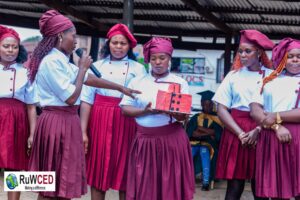
“Today we celebrate more than certificates. We celebrate second chances, restored dignity, and the power of a welcoming hand. Many of us arrived at RuWCED feeling vulnerable, unsure, and searching for meaning. Here we were not only taught, we were believed in. We were welcomed, accepted, and given skills that will change our futures… To every teacher across these departments: you welcomed us with open arms. You taught with patience, laughter, high standards, and real care. You listened when we struggled and pushed us when we needed it. For your time, for your encouragement, and for the skills you gave us freely, we are forever grateful. Training at RuWCED did not stop in the classroom. After our courses, we were sent for a month-long internship in open commercial areas so we could experience real work, dealing with customers, managing time, handling money, and learning the rhythm of business. Those weeks were priceless. They taught us how to turn classroom skill into market service, how to adapt under pressure, and how to present ourselves with confidence. For many of us that internship was the bridge between learning and earning. Thank you to everyone who arranged and supervised these placements, they made our training complete. We will carry RuWCED in our hearts. We promise to lift the flag of RuWCED high, in our homes, markets, workplaces, and communities, God being our helper. We will put these skills to work, start small businesses, support our families, and give back where we can. We will teach others what we have learned. We will be living proof that your investment in us was not wasted.”
According to Neh Mirabel, Administrator of the Bamenda branch, the program began with over 100 trainees from diverse educational and social backgrounds. Through adaptive teaching methods, including instruction in English, Pidgin, and French, 82 resilient students completed their training.
They were trained in:
-Fashion Designing and Dressmaking
-Hairdressing and Beauty Therapy
-Computer and Secretarial Duties
Cookery and Catering
-Agroecology and Organic Farming

She added that graduates also completed a one-month internship in commercial settings, gaining hands-on experience in customer service, time management, and business operations, bridging the gap between training and income generation. She later called on the government and partners to create better conditions such as access to finance, infrastructure, and supportive policies, so that these young entrepreneurs can grow their businesses.
“The training is given free of charge so that every vulnerable youth out there especially girls will not be limited in their desire for skill acquisition. However, training and graduating them is not enough. Our wish is that the government should create enabling an environment that is infrastructure, economic, political, and social conditions for these grandaunts to thrive.”
In line with innovation and environmental responsibility, VTIRuWED also announced the launch of a new department in Earth Brick Fabrication and Sustainable Masonry, promoting eco-friendly construction practices and open up more job opportunities.
Behind the statistics are powerful personal journeys of resilience and change.
For Aishatou Oumarou, a graduate of Fashion Designing, the training challenged long-held beliefs about women’s roles in her community.
“Growing up as a Muslim, I have always been made to believe that women in my religion are not suppose to work. However I saw that this belief made many women dependent and vulnerable, sometimes exposed to violence. After I dropped out of school because of the crisis, I had nothing to do. An aunt told me about this training where I enrolled to learn a skill for myself. This training gave me purpose. I am very happy to be graduating today because I can now provide for myself and inspire other girls in my community to also learn a skill rather than just roaming about the community, getting married and giving birth to children. Thank you VTIRuWED.” Aishatou expressed.
Victorine Yakum, a university graduate who trained in Cookery and Catering, now plans to open her own restaurant.
“Upon graduation from the University of Bamenda, I was greatly affected by the crisis and I needed a skill that could help me put food on my table. I came across the trainings at RuWCED and I decided to enrol into the department of cookery and catering where I acquired great skills in it. It has been an incredible journey this while and I hope to open a restaurant where I can use food to impact others just as RuWCED has done to me.” Victorine conveyed.
Others are already seeing tangible economic outcomes.

Azong Ransoma, once struggling academically in agriculture at the University of Bamenda, is now excelling in farming and has been shortlisted for a micro-agricultural grant with mentorship support thanks to VTIRUWED. Fienge Godwill, also from the agricultural department, has established a flourishing vegetable and fruit farm that produces vegetables, strawberries, grafter fruit trees, leeks and waterleafs, turning knowledge into income.
In the beauty sector, Tchinda Esperance has already opened a beauty shop where she does hair, nails, and makeup, and plans to expand and train others.
Present at the graduation ground was the Divisional Chief for Employment and Vocational Training Ngoketunjia, Representing the Divisional Delegate for Employment and Vocational Training Ngoketunjia and the Divisional Delegate for Women Empowerment and the Family, Mezam, who gave encouraging words to the students and applauded RuWCED for the work they are doing. They equally expressed their utmost support towards the center. The Divisional Chief for Employment and Vocational Training Ngoketunjia, Representing the Divisional Delegate for Employment and Vocational Training Ngoketunjia encouraged the students to keep aiming high, using herself as an example as she mentioned that she equally started in a vocational training like them and today she has been integrated into the government to supervise vocational trainings.
The story of VTIRuWED is one of impact and accountability, showing that when training is practical, inclusive, and focused on real needs, it can truly change lives. For these 82 graduates, the journey is just beginning. But with skills in their hands and confidence in their hearts, they are no longer defined by crisis. They are building their own futures.


